March Craft Article: Writing Korean Sijo / David Jibson

Our craft article for March is from PSM board member, Dave Jibson, who takes us on a dive into Korean Sijo. First appearing in 14th century Korea, Sijo is longer than Haiku and goes beyond imagery into story telling. We think you’ll like playing around with this one. Maybe you can bring one or two to the Spring meeting. Read the article HERE.

Here’s an excellent example from member Ginny Grush.

Writing Prompt / David James

As we tick off the days through summer, here is a writing exercise that uses psychological and philosophical writing to inspire us. Read the excerpt and use its tone, message or phrasing as a seed in writing your poem.

“If while washing dishes, we think only of the cup of tea that awaits us, thus hurrying to get the dishes out of the way as if they were a nuisance, then we are not “washing the dishes to wash the dishes.” What’s more, we are not alive during the time we are washing the dishes. In fact we are completely incapable of realizing the miracle of life while standing at the sink. If we can’t wash the dishes, the chances are we won’t be able to drink our tea either. While drinking the cup of tea, we will only be thinking of other things, barely aware of the cup in our hands. Thus we are sucked away into the future—and we are incapable of actually living one minute of life.”

~Thich Nhat Hanh (Book: The Miracle of Mindfulness)

Pick a mundane task and write about it as if it is the most important and life-giving task in the world, a task that will change your life for the better.

Good luck.

David James

Letting Go

davidjamesAs we begin winter in earnest, I’d like to share some writing exercises that use psychological and philosophical writing to inspire us. Read the excerpt and use its tone, message or phrasing as a seed in writing your poem.

“There is a beauty in the letting go, in the surrender to the unknown, to the inevitable. It is a beauty that is often overlooked, overshadowed by the fear of loss, of change. But it is a beauty that is nonetheless real, and it is a beauty that is worth embracing. When we hold on too tightly, we choke the life out of what we love. We become like the vines that strangle the trees, the weeds that suffocate the flowers. We must learn to loosen our grip, to allow things to flow, to change, to be.”     ~Heidi Priebe (Book: This Is Me Letting You Go)

            Write a poem in which you LET GO of someone or something you love, something you want to keep forever. Surrender in your writing “to the unknown.”

Good luck and have fun! Please stay warm, too.

David James

Poetry Prompt

Today I”m going to jot a poem down without a lot of thinking. I’m going to choose one word (probably something nature but for sure a noun) and use it as much as seems prudent in the poem. Then I’m going to the dictionary like Harryette Mullen and look up my noun. When I find out, I’m going to count 7-10 nouns away in either direction and find a substitute for the chosen noun. I’ll go back to my poem, substitute it and see if there are any interesting lines or phrases that work. Perhaps it changes everything for the better. Perhaps it’s stupid. You won’t know til you try.

Elizabeth Kerlikowske

Prompt: Lesson in Elegy

Read the poem “Your Birthday in the California Mountains” by Kenneth Rexroth. Write an elegy the way he does, misleading the reader that the subject of the elegy is still alive. Address the poem to the person who died. Keep it simple, clear, straightforward, and honest. From In the Palm of Your Hand by Steve Kowitt.

Elizabeth Kerlikowske

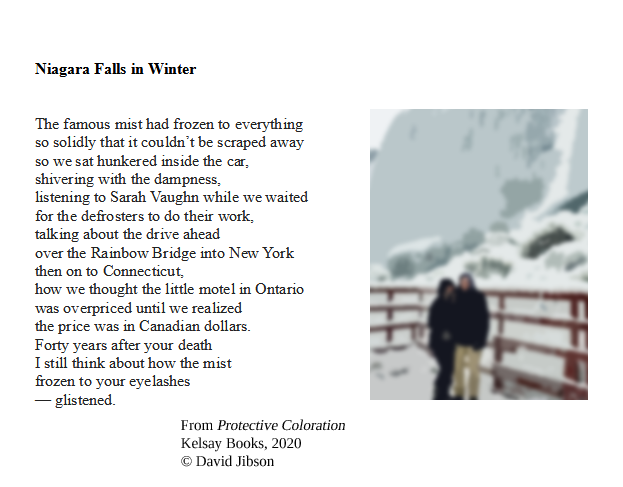
A Member Responds: Niagra Falls in Winter – David Jibson

Prompt: The Right to Write

From Julia Cameron’s The Right to Write.Set aside a half hour:

Settle yourself in to write. First take ten minutes to describe where you are. (I’m in my office and furious.) Try to capture your mood, the room, anything delightful or interesting that catches your attention. Number your paper from 1-5. Very quickly list five things that would be interesting to write about. Choose one topic. What would you write about it? Why would you write about it? Spend five or so minutes writing about that.Do not go for Art, capital A, or even writing, capital W. Think of this instead as word play. Do not worry about being deep or sensible or practical.

Elizbeth Kerlikowske