

Buddha Visits Upstate New York / Elizabeth Rae Bullmer
Dear Friends in Poetry:

Link for Julia’s obituary. Julia’s daughter Kathy reached out to us to share the news and that Julia wished for PSM to receive any memorial gifts and have included us in her obituary. How very sweet, how very Julia.
By David Jibson (notes from the Spring Conference)
Like many people, I came to writing poetry later in life, starting in my late fifties. After a few years of posting to a micro blogging site anonymously, I was ready to seek “legitimacy” through journal publication, so I began submitting and before long, I had some success. A few more years and I felt I had enough published poems that I should start thinking about a book. I put a manuscript together, did some research and chose a publisher that seemed likely to accept it. I was right. A couple of weeks after submitting it, my manuscript was accepted by a small press that specializes in publishing poetry by lesser known and new poets.
The quality control my publisher used was a requirement that about a third of the poems in the manuscript had to have a prior publication credit. I exceeded that, choosing only poems with a publication history to include in my book. My goal was to have a published book of poems that an editor somewhere had already selected and published.
I knew going in that small publishers, including mine, didn’t have the resources to do much marketing. I was perfectly accepting of that limitation. I would buy author copies, schedule readings with local book stores and poetry groups where I could, and attend open mic opportunities. I also set up an author web page and social media accounts so I could do my own marketing without spending a lot of money.
My book was published in March of 2020, just as the country and the world went into covid lock-down so my own marketing plans were blown up. My publisher made the publication announcement to their mailing lists and on their social media platforms. I published sample poems on my author website and social media, but that was the end of it. No readings, no open mics – just a couple of reviews on Amazon and on my local library’s blog.
A couple of years later, I was thinking about another book, so I took a deeper look into my previous experience beginning with some research about various models that publishers use. I discovered some troubling truths about poetry publishing.
One thing I learned is that poets at my level do not make money from having their books published. Only the publisher makes money. That’s how publishing poetry works. In my case, I knew that my publisher would make more than I did whenever a copy of my book sold from their web site or from Amazon – much more.
I learned that small publishers that want to profit have to publish a lot of titles because even their best-selling poets sell a few hundred copies at most and that most poetry books sell fewer than fifty copies. Those who do sell hundreds did so because they, and not the publisher sold them. That’s right, your publisher is not working for you – you are working for your publisher. You buy your author copies at a substantial markup, you sell them from your own website or at readings, book fairs or whatever and no royalties come to you from selling those author copies because your publisher has already made their profit from selling to you.
As poets, the numbers are not in our favor. To begin with, my published book is too expensive. How can I expect to sell a book of poems that costs more than a book by a well-known poet? Paperback books by Billy Collins, Ted Kooser, Naomi Shihab Nye or Ocean Vuong sell for between seven and sixteen dollars, depending on how old they are. The publisher set the price of my book at $18.50. I had no say in that. The author price for the copies I bought (I did get 5 free copies) was ten dollars each, a substantial discount, but that’s the price for me to buy copies of my own work and at that price, the publisher is making more from me than from any other sales.
I did some thinking about what I really wanted out of publishing my poetry and the conclusion I reached is that I wanted to share it with other people who appreciate poetry. I concluded the best way to do that is not through the traditional means open to me. I took a close look into self-publishing. I crunched some numbers. I found that I can get printed copies of a book of between 24 and 100 pages for about $2.50 each (about $2.75 with shipping). At that price I can take books to a reading and sell them for three bucks or, better yet, I can give them away for free. But why stop there? Why not use my author website to give away free digital copies? If the sole purpose of publishing is to share my work as widely as possible, what could be better than making it free?
That’s exactly what I did with my next book, a chapbook that I published myself, I ordered thirty copies and sent them to my poetry friends. I was asked to do a presentation on self-publishing at a meeting of a state poetry society. I ordered fifty more copies and gave them away at that meeting. In the first six months the free version was downloaded 107 times from my web site and. on Amazon, ten print copies were sold for a minimal price.
This article was about the “why” of self-publishing. The “how” of self-publishing is something you can research on your own just as I did. I will tell you, there is a learning curve, but not one that’s insurmountable for most people. Learning is no more difficult than a 100-level college course.
Visit my author website to download free copies of several of my self-published books.
https://www.youtube.com/channel/UCcz0OrXKcVB5PgbakEu7wDw
Follow this link to David’s reading of May 24, 2023 and all and all of the readings in the Crazy Wisdom Series:
Naomi Shihab Nye—“Kindness”–https://poets.org/poem/kindness
Naomi Shihab Nye’s poem, “Kindness,” has been for me both a source of inspiration and solace. In this poem she takes us with her on an ordinary bus ride to remind us that “Before you know what kindness really is/you must lose things.” I have a sister who is terminally ill and it seems all I have to give her right now is kindness. But Nye tells us in this poem that kindness is the only thing “that makes sense anymore,” that it can go with us “everywhere/like a shadow or a friend.” In addition to this being a beautiful poem, it is a fine example of how poetry can bring grace when it seems there is none.
Catherine McGeehan
On Visiting Herbert Hoover’s Birth and Burial Place by Thomas Lux
I admire Thomas Lux’s villanelle, “On Visiting Herbert Hoover’s Birth and Burial Place,” especially because the conversational banal tone hides misfortune. At the prairie’s edge, tents flourish, a reference to Hoovervilles. His message is still relevant: “What you spent was what you earned and not a dime in banks accrued.” Like then, “so many people can’t pay their rent.” The speaker is also humble, saying if he is wrong, he ‘repent[s], but don’t too many people dream of meat in their soup?” The greater divide between rich and poor—“some eat white bread, some get screwed”— due to greed is repeated. But would we, if in power, make any difference? The confusing syntax in the middle asks, “. . . how, can we prevent our oblivion?”
Janice Zerfas
I love Sir Thomas Wyatt’s poem “They Flee from Me” and I find it so intriguing that I assigned it in every class I taught for many years. “They flee from me who sometime did me seek.” Oh, well, who hasn’t felt that? Ostracized again! He likens his courtly companions to deer, and they’re apt comparisons. I see a lot of deer. Bonus: it’s the first use of the term “newfangleness” in literature, which I thought was more newfangled than the 1500’s. Although he ends up jilted, he has made me love him. Link to They Flee from Me.
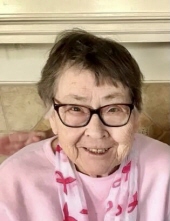 Born May 31, 1930, to Joseph Earl Smith and Olive Birdie Jenkins Smith, she was the youngest of four children. Her early years were spent on a farm in rural Michigan. She graduated from Bay City Central and earned her teaching degree from Central Michigan University. Joye married Philip Giroux in December 1951. She taught French and English at South Lake High School in St. Clair Shores, MI and Big Rapids High School during her years as a beloved educator. She was a poet who initially wrote to ease the pain of losing her husband, Philip, to cancer in June 1969. She went on to serve as President of the Poetry Society of Michigan and publish several books. Full obituary HERE.
I am not going to say it is cold,
But when you milked the cows,
They gave ice cream,
And you could knock over
Any frozen goat.
The chickens hatched penguins,
And the horse snorted
Ice-sickles.
The windows of the house
Glazed over,
And as the inside heat
Melted the ice,
It became running rainbows.
The thermometer
Plunged to ten below zero,
And the trees exploded
Like cannon shots.
Now that was cold,
And if you believe me,
I will tell you another
Tall tale.
Emory D. Jones / Iuka, MS
 Poetry Society of Michigan