
From the Spring 2020 issue of Peninsula Poets. We’ll be posting something every couple of days.

From the Spring 2020 issue of Peninsula Poets. We’ll be posting something every couple of days.
From the Literary Hub: The 32 most iconic poems in the English language. (with links)
From Western Wind, an Introduction to Poetry edited by David Mason and John Frederick Nims.
Write a poem alluding to a song or literary work that only someone of your generation would know. Can you make your poem comprehensible to readers of other generations?

Syllabic verse: count syllables. It can help shape the poem. I had a poem yesterday that was doing nothing, so I thought maybe syllabics would help. I counted the first line: 12 syllables. I counted the second: also twelve. The first four lines were all twelve. This was educational. It’s a better poem now. Like rhyme, syllabics force you to reconsider your word choices. Try it with a floundering poem, not that you have any of those.
Eye of newt: Write a spell to make something happen or to change something. Be sure to use lots of relevant details to help the casting.
Pretend that when you were born, you came with an instruction manual for your parents. What would it say?
Read some Russell Edson pieces. Then write one of your own.
From A Poetry Handbook by Mary Oliver: Read Elizabeth Bishop’s The Fish. Write a poem using lots of specific descriptions: metaphors, similes, and details (which Oliver calls “texture.”)
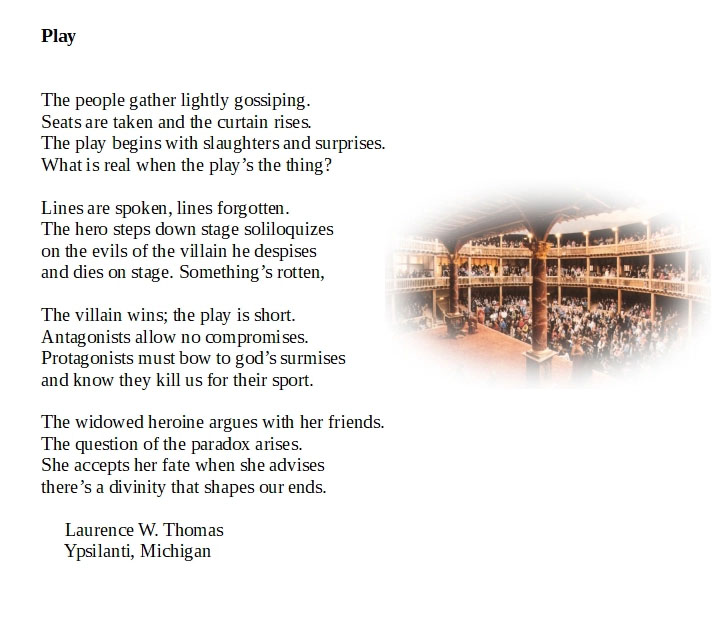
Reading poetry can be good in hard times. Writing poetry can be better. How else do we figure out what is truly on our minds unless we set it down on the page? Because we are not seeing many people now (I have seen four people other than my husband and the mail carrier since early march) it is more important than ever that we communicate, even if it is with ourselves. Poetry Society of Michigan Chancellor and founding editor of 3rd Wednesday Magazine Laurence W. Thomas turns 93 today!
 Poetry Society of Michigan