before I see them scree scree at regular intervals, doppler waves sounding the distance flattened wings circle thermals overhead,
or the chorus of shrilly scolding bird flocks chasing until it drops its young prey, or squawking chickens when they see a shadow of this predator too late to flee,
or the soft unexpected thwup on fence when it lands, as stunned as I am, a heart leaping arm’s length away, eyes devouring me where I stand.
Between the yardstick and the mile The Rumor animates fields of Anemones. It feeds the fish that drinks the rain. It turns the plumes of broad winged hawks, Huffs into sails of lonely ships. It warms the tomb with candle flame And further than this star. All things breath in its trace, Taste with its tongue, Belie the exigence of form. And in a book I read, The wounded heart was freed Upon a day when the rain fell up.
Can one dream of what can never be? Is it outside of human possibility? Words and words thrown at the corner Where no one stands.
Write about something that changes over time. Could be you and an attitude. Could be a chair gathering snow. Could be the deer settling down. Could be your car rusting away.
From friend Eben Gering: Write a poem about a carnival ride. Then get in a brawl with it at the end. ( I don’t exactly know what that brawl part is about, but carnival rides: what a rich source!) Thanks, Eben.
Read the poem “Your Birthday in the California Mountains” by Kenneth Rexroth. Write an elegy the way he does, misleading the reader that the subject of the elegy is still alive. Address the poem to the person who died. Keep it simple, clear, straightforward, and honest. From In the Palm of Your Hand by Steve Kowitt.
Elizabeth Kerlikowske
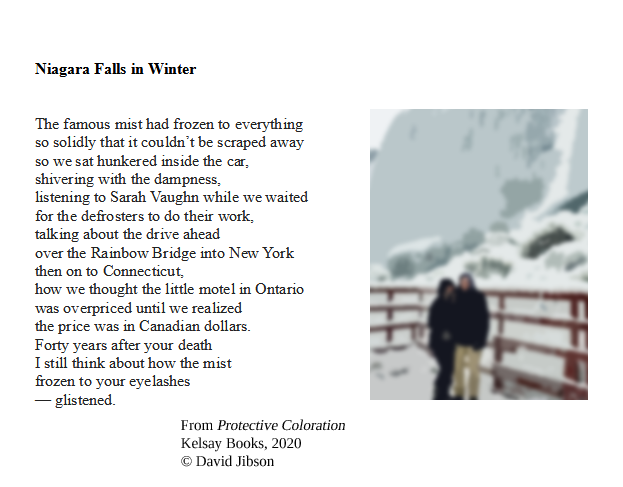
A Member Responds: Niagra Falls in Winter – David Jibson
No birds call, no crickets sing No wind blows through no trees No words echo, no flowers spring No self has no value here No heart beats, no pains sting No way up to no way down No way left for my being No way right, no way wrong No way out of no seeing No feet on no ground No me to know the meaning.
The meadowlark, belting his song from a post on this book’s cover, is recognized across the country as a harbinger of spring. Enlivening the ambiance of this poetry collection, familiar birds represent the character and mood of its four sections: noisy jays, melodious wrens, steadfast robins, tranquil swans. While birds populate many of the poems, hardly more than a handful have birds as their subjects. The poems’ subjects derive from wide ranging personal experiences often narrated as dramatic situations, usually with something emotionally important at stake. Settings are urban and rural, delineated in finely tuned sensuous detail. Some poems are sonorously lyrical, others ironic or assertive.
“Publication of Edward Morin’s The Bold News of Birdcalls is good news not just for birders and other celebrants of the natural world, but for all poetry lovers. I love Ed Morin’s sense of place; he is a real Michigan bard, and his evocation of many familiar Michigan places amounts to a North American version of what the Irish call Dinnṡeanċas, “place lore,” the recitation of which is one of poetry’s most ancient and revered obligations. All this is accomplished with human warmth and a rare sense of empathy.” — Richard Tillinghast, author of twelve books of poetry and five of creative nonfiction, most recently Journeys into the Mind of the World: A Book of Places.
“Birds flutter, feed, and swoop through these poems: motifs that knit together subjects as closely-observed as a decaying Hallowe’en pumpkin, armed robbery at a paint store where the speaker holds short-lived employment—a narrative that had my heart in my throat!—and elegies for early-passing friends, colleagues and poet-pals from the speaker’s younger years as a university instructor. Academic politics of the corporate university also grip our attention, as does some professorial ogling! The unforgiving contrasts of northern Midwest weather serve both to warm and cool the tonalities of poems filled with self-questioning, forgiveness of others, and compelling human stories.” — Carolyne Wright, author of This Dream the World: New & Selected Poems, and lead editor of Raising Lilly Ledbetter: Women Poets Occupy the Workspace
From Julia Cameron’s The Right to Write.Set aside a half hour:
Settle yourself in to write. First take ten minutes to describe where you are. (I’m in my office and furious.) Try to capture your mood, the room, anything delightful or interesting that catches your attention. Number your paper from 1-5. Very quickly list five things that would be interesting to write about. Choose one topic. What would you write about it? Why would you write about it? Spend five or so minutes writing about that.Do not go for Art, capital A, or even writing, capital W. Think of this instead as word play. Do not worry about being deep or sensible or practical.





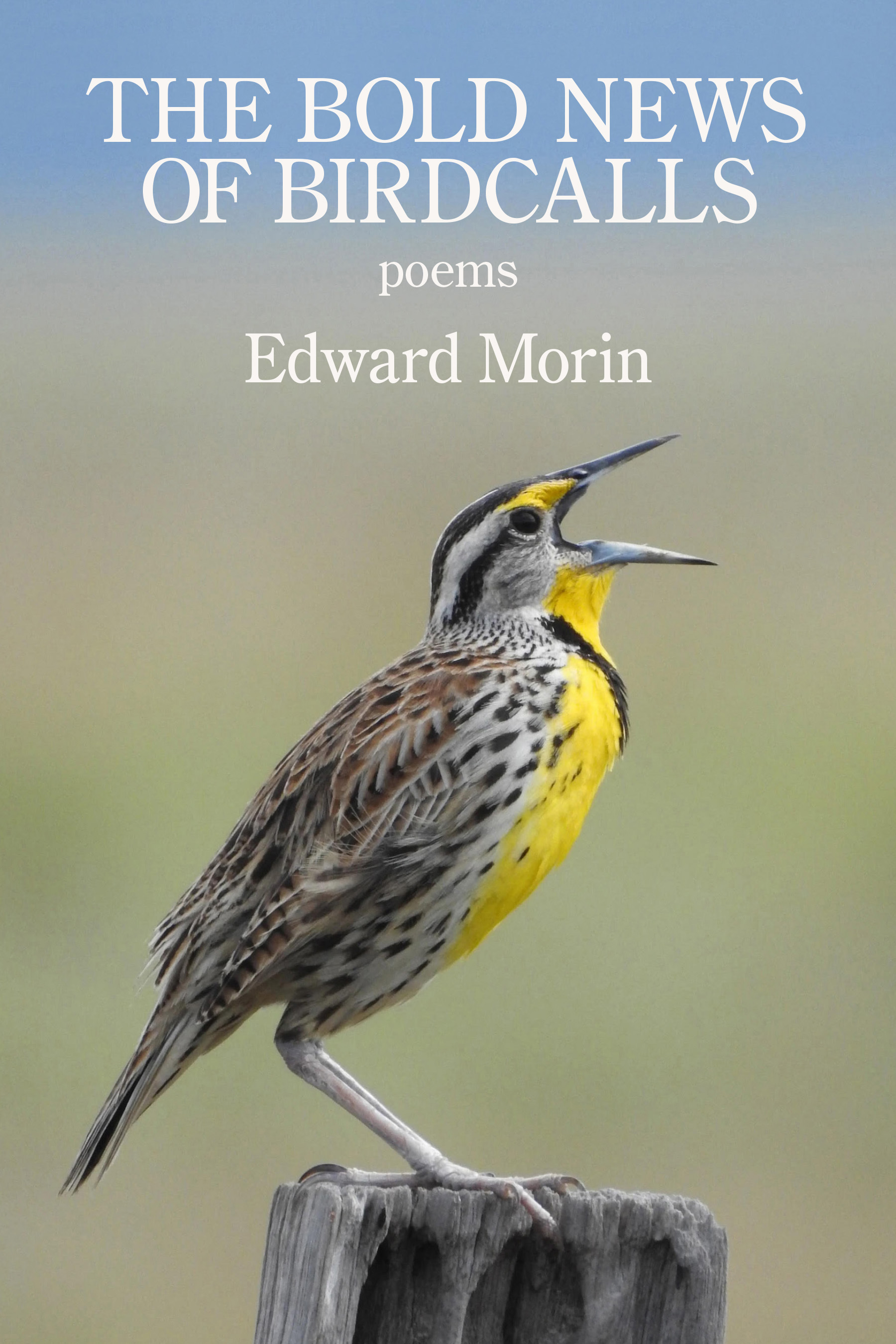 The meadowlark, belting his song from a post on this book’s cover, is recognized across the country as a harbinger of spring. Enlivening the ambiance of this poetry collection, familiar birds represent the character and mood of its four sections: noisy jays, melodious wrens, steadfast robins, tranquil swans. While birds populate many of the poems, hardly more than a handful have birds as their subjects. The poems’ subjects derive from wide ranging personal experiences often narrated as dramatic situations, usually with something emotionally important at stake. Settings are urban and rural, delineated in finely tuned sensuous detail. Some poems are sonorously lyrical, others ironic or assertive.
 Poetry Society of Michigan