
Take something you love, something you hate, something you don’t understand. Put them in the cement mixer of your brain and write a poem. Below you’ll find a response to this promt from Becky Ventura.
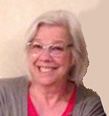
Take something you love, something you hate, something you don’t understand. Put them in the cement mixer of your brain and write a poem. Below you’ll find a response to this promt from Becky Ventura.
Sparely, create a setting that doesn’t exist. Make sure there’s earth, air, water and fire in some analogous form. (Fire: matchstick, candle, hot sauce, shame.) This is the moment after something has happened. Do NOT be explainy. Write the poem/prose poem. No “I” allowed.
Write a poem that celebrates some special occasion, whether it be an epithalamium for a marriage; an elegy for someone who has passed away; or an ode which can commemorate anything from a battle to a hangnail. From Writing Poetry by David Starkey (no relation to Ringo)
Write about a time you mistook something for something else. Once I thought a person was flagging my car down in the dark, but it was a garbage bag wrapped around a tree. Today a branch blows in such a way that it looks like someone is walking past.
…”
I had a post up a couple of months ago having to do with writing about death. Someone complained that now was no time to do that. I disagree. Death is a fact of life and cannot be ignored. From In the Palm of Your Hand by Steve Kowit. Write a poem in which you are reminded that you too will one day die. It could be prompted by something you see (roadkill) or a song loved by someone who’s passed. Talk about the objects more than your feelings. They will come through.
Here’s an example by Ted Kooser, Death of a Dog.
From The Mind’s Eye by Kevin Clark: Journey Poem. Write a poem in which you take a trip and end up in a place totally unexpected, perhaps a foreign countryside or in the throes of an exciting and/or suspenseful discovery. Tell the story while focusing on graphic action verbs.
From Western Wind, an Introduction to Poetry by Mason and Nims.Make a list of your five favorite nouns, five favorite verbs, and three favorite modifiers. Try writing a poem using all of these words in any combination.
From Writing to Awaken by Mark Matousek. Write about your relationship with routine. Are you rigidly attached to your habits? If so, which ones and why? How does attachment to routine limit your ability to be spontaneous?
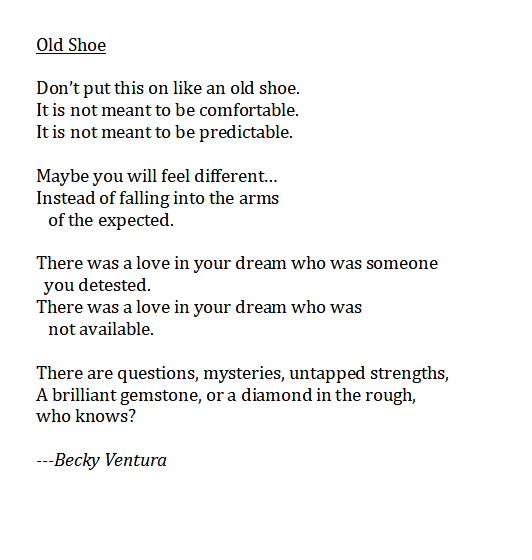
This poem was featured at the fall meeting of the Poetry Society of Michigan. It was a response to a prompt from Elizabeth Kerlikowske, the current president of the organization. “Write a poem giving someone advice… It could be an extended metaphor. And fun/clever/don’t even think of rhyming.”

From girlswritenow.org contributed by Robin Church. Choose a photograph. Write a poem from the perspective of the character n it. Be sure to use details in the photo as images in the poem. Focus on creating a distinctive and and consistent voice.
Here’s an example from poet, Richard Blanco: Photo of a Man on Sunset Drive: 1914. (Full text of the poem here). Notice how Blanco describes a scene from a hundred years ago. From there, he goes on to tell us how this scene has changed. His poem is a time machine of sorts that carries us back and forth through time at the same location. This is a great way to build a poem around a photograph, going well beyond description of the photo itself.
Another technique is offered by poet and teacher, Steve Kowit in his book, In the Palm of Your Hand. He suggests a poem in three parts:
1) Describe briefly what is in the photo, focusing on just a couple of details.
2) Animate the photo by suggesting movement or other sensory input.
3) Enter the picture and interact with the objects or people in the photograph.
Here’s a poem demonstrating Kowit’s technique from The Ekphrastic Review that was written by one of our PSM members.
 Poetry Society of Michigan