

Links:
The Space Between Us on Amazon
Karin’s other books on Amazon
Karin’s other books on Bookshop.org
Additional copies, please email: klhpoetlover@gmail.com
The Space Between Us on Amazon
Karin’s other books on Amazon
Karin’s other books on Bookshop.org
Additional copies, please email: klhpoetlover@gmail.com
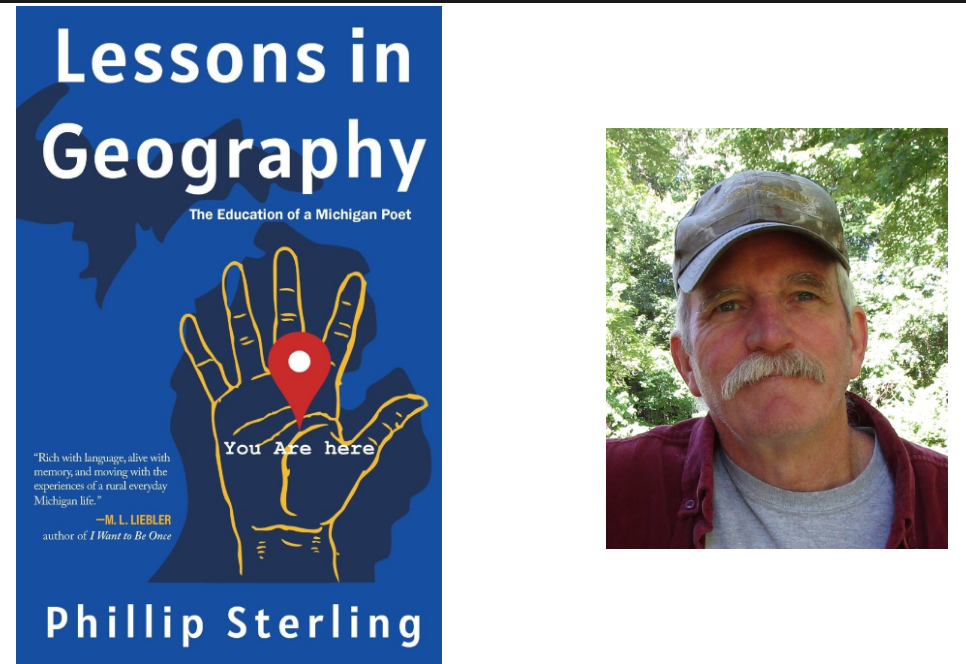
Written and published over a period of forty years, the essays in Phillip Sterling’s Lessons in Geography chronicle how his formative years in Northwest Lower Michigan not only inspired him to be a writer but also profoundly influenced his creative and critical perspectives. Diverse in form, the essays are nonetheless unified in theme: how the geography of a place—the forests, shores, and lakes of Michigan—plays a role in one’s education, imparting knowledge of the wider, human world.
Phillip Sterling is a poet and fiction writer. His books include Mutual Shores (2000), In Which Brief Stories Are Told (2011), Amateur Husbandry (2019), and Local Congregation (2023). He is the recipient of a National Endowment for the Arts Fellowship in Poetry, two Senior Fulbright Lectureships (Belgium and Poland), a PEN Syndicated Fiction Award, and artist residencies at Isle Royale National Park and Sleeping Bear Dunes National Lakeshore. He lives in Lowell, Michigan.
Phillip Sterling was born in the metro Detroit area and raised largely in rural West Michigan. Like earlier Michigan poets/essayists such as Theodore Roethke and Jim Harrison, Sterling, in these lovely essays, explores both the external and interior dichotomies of settled/unsettled and domestic/wild. And like his predecessors, Sterling manages to convey genuine, moving sentiment without becoming sentimental. This is a book about a poet’s sometimes perilous coming of age, and of aging with grace and acceptance. —Sue William Silverman, author of Acetylene Torch Songs: Writing True Stories to Ignite the Soul
Whether writing of his northern Michigan boyhood, ancient trees, Mom’s custard pie, dog bites, Belgian frites (French fries), or the abandoned death camps of Poland, Sterling brings wide-ranging insight, an in-depth sense of history, self-effacing wisdom, and the marvelous double vision of the true memoirist to these essays. His “lessons” build chronologically to depict the development of a writer’s imagination with the deftness that marks his signature poetry, both complex and captivating. This fine work is a significant contribution to the Great Lakes “Voice.” —Anne-Marie Oomen, author of The Long Fields and recipient of the 2023-24 Michigan Author Award
In Lessons in Geography: The Education of a Poet, Phillip Sterling distills a lifetime of lessons learned in places as varied as an “Up North” Michigan lakeside cottage, a Kentucky college mailroom (where a mysterious sketch and message on a paper bag affirm his identity as a poet), and Liege, Belgium, where he explores the nuances of “mutual understanding” in light of Belgian kissing customs. Whether describing the “roguish” appeal of black licorice or dissecting a recipe for stollen, ingredient by memory-laden ingredient, Sterling mixes keenly observed experiences with fresh perspectives, all rendered with a poet’s sensitive precision. The result is a memoir that transcends mere recollection. —Nan Sanders Pokerwinski, author of Mango Rash: Coming of Age in the Land of Frangipani and Fanta
Phillip Sterling is one of Michigan’s finest and best known poets and fiction writers. In this new collection, he raises the non-fiction bar to a new level. These wonderfully crafted essays are rich with language, alive with memory, and moving with the experiences of a rural everyday Michigan life. I highly recommend this book. Lessons in Geography is one of the most engaging and accessible memoirs I’ve read in recent years, a beautifully written narrative about place and the poetry it inspires. —M. L. Liebler, Detroit poet, editor, and author of Hound Dog: A Poet’s Memoir of Rock, Revolution and Redemption
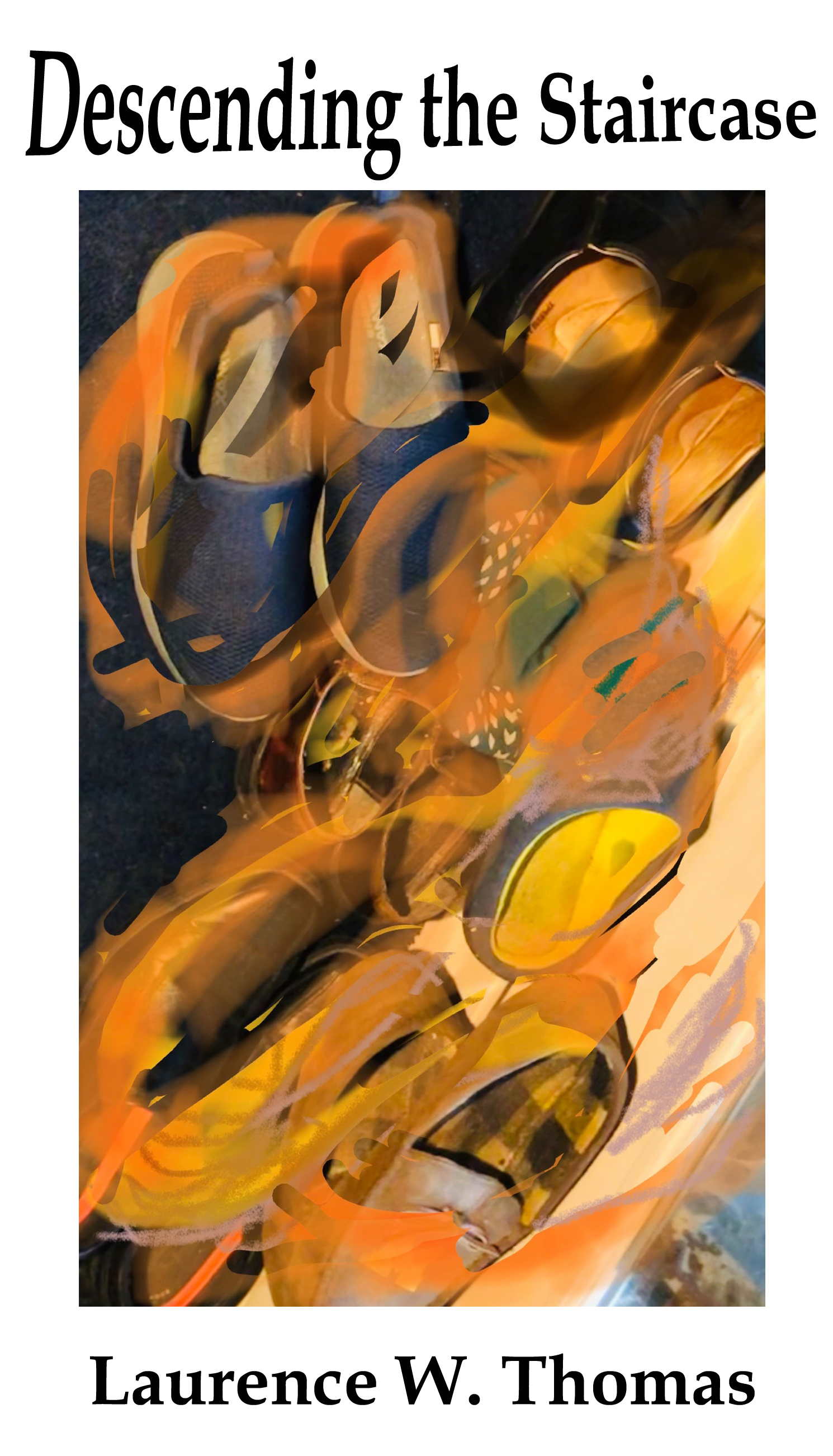 Larry Thomas has a new book out. You can read it for free online or order a print copy from Amazon. Click on the cover image for details.
“The dream aspects of surrealism come to me naturally. Like most people, I dream frequently and vividly, sometimes so nightmarish that I force myself to wake up in order to escape the fear and horror. Interpretations of dreams are largely guesswork, Freud notwithstanding, and retelling them, impossible. But in those dreams, people, places, and happenings appear in incongruous juxtaposition and contortion providing the basis for surrealistic writings. Some of the poems in this collection are taken directly from such nocturnal experiences recollected through veiled layers of time and the continuous blanketing of subsequent happenings.” – L. W. Thomas
 With In Which We See Our Selves, Eric Torgersen begins with the formal structure of the ghazal as popularized by Agha Shahid Ali and unapologetically makes a more American thing of it, arguing in his Afterword that this transformation is as inevitable as what happens when the children of immigrant parents pass through an American junior high school: not everyone is pleased with the result. “I’ve tried to avoid faux-Eastern themes and tones,” he writes. Fluently metrical and effortlessly rhymed, at times in short, hard-hitting lines with refrains as brief as a single word, these poems leap off the page with speech as American as this:
My gang all quit when I didn’t split the take right.
We crashed and burned when I didn’t hit the brake right.
(Click the cover photo to order from Mayapple Press)
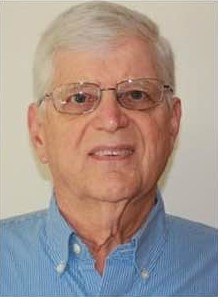 Eric Torgersen was born in Melville, New York. He has a BA in German Literature from Cornell University; after two years in the Peace Corps in Ethiopia, he earned an MFA in poetry from the University of Iowa. He retired in the spring of 2008 after 38 years of teaching writing at Central Michigan University. He lives in Mt. Pleasant, Michigan with his wife, the quilt artist Ann Kowaleski. Since retiring, Eric has volunteered for the Chippewa Watershed Conservancy. He enjoys fishing and foraging for wild mushrooms. He is available for workshops and readings.
Mr. Torgersen is presently serving a two-year term as Honorary Chancellor of the Poetry Society of Michigan.
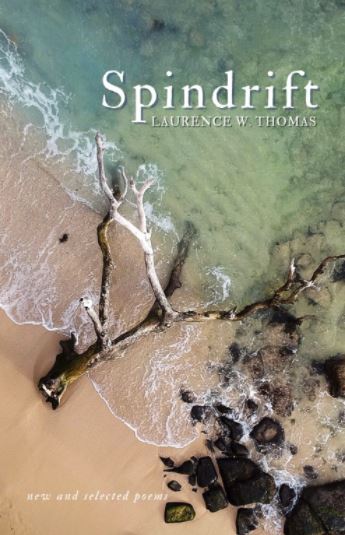 Spindrift suggests stuff blown onto beaches, beaches of discovery in one’s mind. When these poems show a squirrel, a fish, birds, a beggar, an Irish pub, or a dish we see these as metaphors which conjure up ideas or feelings from our own familiarity with them. A poem that begins as an abstraction, like an enemy or peace or patience, becomes objectified. Spindrift is comprised of whatever little gems might be found along the shore, examined closely to become part of the reader’s experience. These jottings of spindrift take off from that experience like going to an airport when you want to be someplace else – or like poems which say one thing when they mean another.
Published by Atmosphere Press, 2021. 124 Pages, ISBN 163649532X
or purchase from Barnes and Noble or Amazon.
 Laurence W. Thomas is the founding editor of Third Wednesday Magazine. He has been around long enough to know the sting of rejection and the salve of acceptance. His shelves are lined with his own publications as well as the works of many other poets. He Chancelor Emertus of the Poetry Society of Michigan.
 Poetry Society of Michigan