Author: Editorial Staff
Favorites / Catherine McGeehan
Naomi Shihab Nye—“Kindness”–https://poets.org/poem/kindness
Naomi Shihab Nye’s poem, “Kindness,” has been for me both a source of inspiration and solace. In this poem she takes us with her on an ordinary bus ride to remind us that “Before you know what kindness really is/you must lose things.” I have a sister who is terminally ill and it seems all I have to give her right now is kindness. But Nye tells us in this poem that kindness is the only thing “that makes sense anymore,” that it can go with us “everywhere/like a shadow or a friend.” In addition to this being a beautiful poem, it is a fine example of how poetry can bring grace when it seems there is none.
Catherine McGeehan
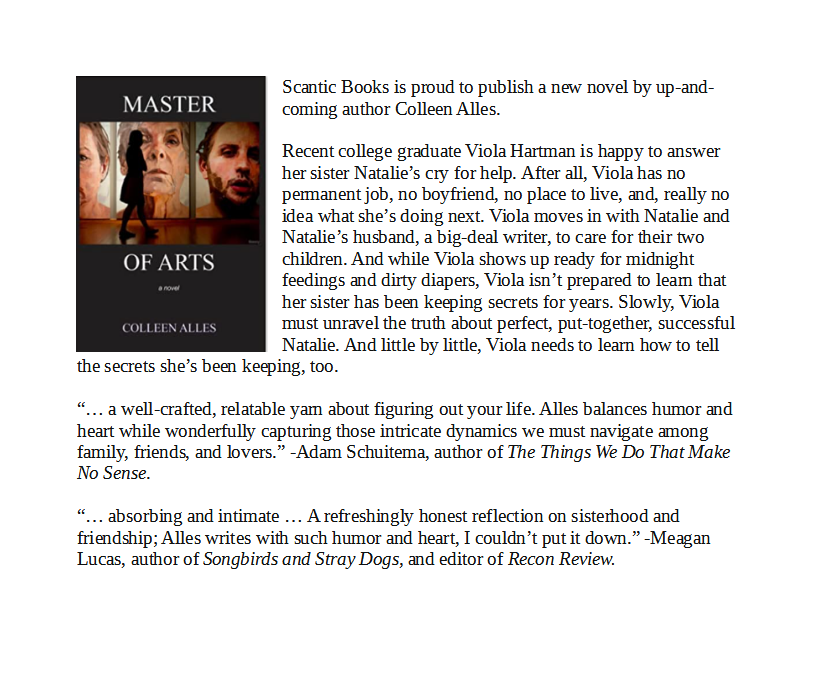
Master of Arts / Colleen Alles

Favorites / Jerry Lang
“The Garden” – Andrew Marvell
As a lifetime gardener, I can’t help but admire Marvell’s “The Garden,” with its metaphorical twists and turns reflecting on themes of human vainglory, nature’s gifts of calm meditative repose, and Biblical references. My introduction to the poem was at a project meeting when it was read by a landscape architect describing a garden design. My favorite part of the poem is in the sixth stanza.
The mind, that ocean where each kind
Does straight its own resemblance find,
Yet it creates, transcending these,
Far other worlds, and other seas;
Annihilating all that’s made
To a green thought in a green shade.
Yes to annihilating all this world’s strivings, trials, and even joys into a green thought in a green shade. Yes to getting back mentally and physically to our home in the natural world!
Jerry Lang
Favorites / Janice Zerfas
On Visiting Herbert Hoover’s Birth and Burial Place by Thomas Lux
I admire Thomas Lux’s villanelle, “On Visiting Herbert Hoover’s Birth and Burial Place,” especially because the conversational banal tone hides misfortune. At the prairie’s edge, tents flourish, a reference to Hoovervilles. His message is still relevant: “What you spent was what you earned and not a dime in banks accrued.” Like then, “so many people can’t pay their rent.” The speaker is also humble, saying if he is wrong, he ‘repent[s], but don’t too many people dream of meat in their soup?” The greater divide between rich and poor—“some eat white bread, some get screwed”— due to greed is repeated. But would we, if in power, make any difference? The confusing syntax in the middle asks, “. . . how, can we prevent our oblivion?”
Janice Zerfas
Favorites / Elizabeth Kerlikowske
I love Sir Thomas Wyatt’s poem “They Flee from Me” and I find it so intriguing that I assigned it in every class I taught for many years. “They flee from me who sometime did me seek.” Oh, well, who hasn’t felt that? Ostracized again! He likens his courtly companions to deer, and they’re apt comparisons. I see a lot of deer. Bonus: it’s the first use of the term “newfangleness” in literature, which I thought was more newfangled than the 1500’s. Although he ends up jilted, he has made me love him. Link to They Flee from Me.
Keeping Out the Noise / Katherine Edgren

Visit 3rd Wednesday Magazine’s YouTube Channel for a reading featuring Katherine Edgren.
Keeping Out the Noise is Available From: Kelsay Books and Amazon
In Ann Arbor: Nicola’s Books, Booksweet,
In Chelsea: Serendipity
In Ypsilanti: Blackstone Bookstore
Favorites / David James
Degrees of Gray in Philipsburg — Richard Hugo
Hugo was an early hero of mine. He still is. His poems are rich and thick with imagery, and they’re fun to read out loud. But he’s also a poet not afraid to journey close to the edge of sentimentality in his writing and then move away. To me, the very best poems, like this one, combine emotion with images, feeling with sensory details in a style that moves us when we read. It’s obvious that this little town, Philipsburg, triggers the poem for Hugo, but the writing takes us below the surface of the human condition, reaching toward truth.
– David James
Favorites / David Jibson
The People of the Other Village – Thomas Lux
This short poem by Thomas Lux, whom we sadly lost a couple of years ago, is one I like to read often. It is so much a poem for today and it expresses one of our least admirable human traits with just the right balance of truth and humor. His mantra “we do this, they do that” capsulizes perfectly how little we have changed in 10,000 years.
-David Jibson